
47 seconds.
That’s how long the average person holds their attention before distraction strikes, according to Gloria Mark. Add to that Johann Hari’s finding that most American workers focus for just three minutes before getting interrupted, and the sobering statistic that we spend 47% of our waking hours thinking about something other than the task at hand.
Taken together, these numbers mark a single crisis: our capacity for sustained concentration has collapsed.
Leaders today don’t fail for lack of ideas. They fail for lack of focus. Studies show that two-thirds of our daily behavior runs on autopilot, but we drastically overestimate the amount of discretionary cognitive time we actually have. For most, it’s 1–2 quality hours a day. That gives you, if you’re lucky, ten hours a week to make important things happen.
What’s worse, those precious few brain cycles are further fracked by notifications, demands, and shiny new opportunities. Without a system, even the most disciplined leaders drown.
What if you had a mental tool that cuts away the noise and channels your limited attention to what truly matters?
Let me introduce you to the Three for Three Focus Framework. You might never work the same way again.
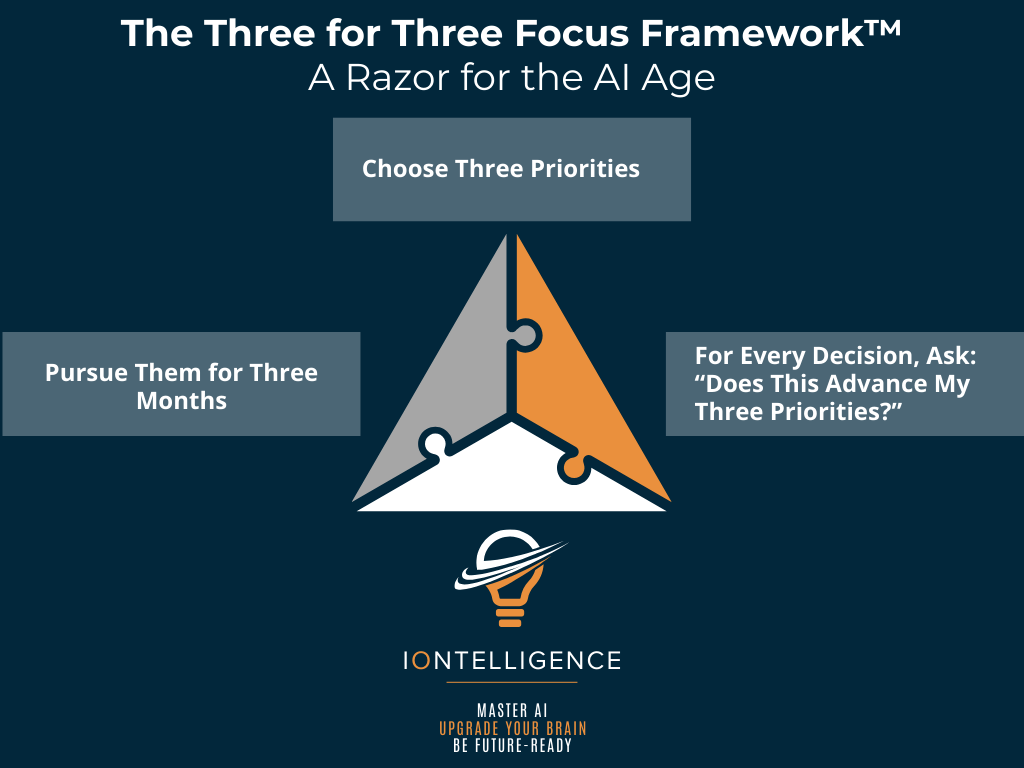
The Big Idea: A Razor For the AI Age
For centuries, philosophers and critical thinkers have employed “razors” as cognitive devices to cut away the unnecessary and focus on the essential. Occam’s Razor is the most famous: the simplest explanation is usually the correct one.
Executives in the AI Age need a new version of the tool – not to explain the world, but to filter it.
That’s why I developed the Three for Three Focus Framework. As a nod to Occam, it has only three elements:
- Choose three priorities.
- Pursue them with ruthless focus for three months.
- Run every micro-decision through a single filter: Will this advance one of my three? If not, the answer is no.
Modern life constantly pulls us from our priorities. This is a tool to wrench it back.
This is not a dumbed-down to-do list or a simple reframing of SMART goals. It’s a decision weapon in a world of mass distraction.
Why It Works
Oliver Burkeman defines focus not as a skill, but as an anti-skill—akin to anti-fragility. It’s the art of resisting the alluring but inessential.
The payoff is obvious: 100% of your energy concentrated on a few essential priorities beats spreading yourself 1% across twenty.
Ryan Holiday puts it bluntly: “Most people get the little things right and the big things wrong — and then wonder why they don’t get much done.”
The Three for Three Razor flips that equation. The first step is to determine your three priorities (more on this below). Once you’ve made those key strategic decisions, the system is designed to be tactical and practical in its implementation.
It works because it:
- Reduces decision fatigue. You always know the answer to “what should I do next?”
- Operates on a quarterly cadence. Three months is long enough for traction, but short enough to pick a new trio of priorities four times in one year.
- Keeps simplicity as a feature. There’s no need for dashboards or Gantt charts—just three choices and one ruthless filter.
Where OKRs become overly scripted and bog down in metrics, this razor drives daily action. It’s not about tracking milestones. It’s about allocating your holy trinity of resources—time, energy, and attention—with consistency and conviction.
I’m convinced the clarity of mind and progress you’ll make in those three months will be transformative. It has been for me. I developed this tool to combat the fragmentation I experienced in my work. I then introduced it to my executive coaching clients, who enthusiastically adopted it.
They reported that they:
- Make faster, crisper decisions.
- Feel more in control because they now make deliberate decisions. They’re driving, rather than reacting to, their workday.
- Experience less FOMO, now that everything outside the Big Three is intentionally rejected.
- Freed up mental bandwidth for strategy and creativity.
- Most importantly, they say it helps them say the hardest word in the English language: “No.”
Why is that last point so critical? Steve Jobs said it best: “People think focus means saying yes to the thing you’ve got to focus on. But that’s not what it means at all. It means saying no to the hundred other good ideas.”
How to Implement the Three for Three Razor
- Choose Your Three Wisely.
- Deciding in advance how to spend our time is the Archimedes lever to this system.
- The first two should come from your “day job”—urgent, essential priorities. However, they should be high-leverage and strategic projects.
- Pause before choosing the third one. It offers the most significant opportunity for creativity and agency. My recommendation: Pick something important but not urgent – a project stuck in the “Someday, Maybe” category for far too long. Ask yourself: What would your future self wish you had started focusing on 3 months ago?
- Aim for balance: work, personal, and health often make a powerful trio.
- Embed Them in Your Workflow.
- Write them down. Tape them to your laptop or bathroom mirror, so you see them every morning.
- Repeat them until they’re as familiar as your kids’ names.
- Schedule daily 90-minute Deep Work blocks to advance them.
- Use the Razor Question for Every Micro-Decision.
- The hardest part of making a plan work is not creating the plan, but rather following through with it day by day.
- Every time a new demand, meeting, or opportunity arises, ask: “Will this advance one of my three?”
- Yes → Do it.
- No → Defer, delegate, or dismiss.
- Review Weekly.
- Audit your calendar. Did your time align with your three?
- If not, course-correct before you start compounding that mistake.
- Audit your calendar. Did your time align with your three?
Your Move
This week, define your Three for Three priorities for the next 90 days.
Every time a fresh request or shiny new opportunity tempts you, pause and ask:
👉 Will this advance one of my Big Three?
This single discipline can rescue your attention—and drive your desired results—in an age built to steal both.